
Sister scheduled to fly out of Brussels airport on the day of the bombings
Justin Renton • March 27, 2016
This past weekend the Paris Church of Christ hosted our third annual Woman's Day focusing on the transforming power of God's love in our lives. "Il m'aime, un peu, beaucoup, passionnément, à la folie!" translating into English as "He Loves Me, He Loves Me Not," spoke to the deep spiritual need each women desires for unconditional love, a love that only God, our heavenly Father provides for each and every one of us, as evidenced by the death and resurrection of his son Jesus!
Over 130 women were in attendance and all hearts were touched by the vulnerable sharing of several sisters. Other sisters moved us by their acting and musical talents, adding comic relief, and inspiration to the day. The student ministry provided a light-hearted and yet profound video, which they filmed across the city to help kick off the day. Servant-hearted women played vital roles behind the scenes, ensuring that each guest felt welcomed and loved. Our wonderful brothers in Christ were present, serving us as ushers.
God's love was evident in every aspect of the day and Christ was glorified and honored. Afterwards, the fellowship consisted of forging new friendships, deep and vulnerable talks, heartfelt laughs, tears and hugs and lasted for almost two hours over coffee and tea. Several sisters traveled from Belgium, Lyon and Geneva to join us. New Bible studies have already begun this week.
Two days later, another devastating terror attack took place at Zaventem Airport and underground at the Maelbeek metro station in Brussels. Many lives were lost, and we were reminded again of the war of hate we are in. As disciples of Jesus we will continue to put our trust in him, and live a life of love.
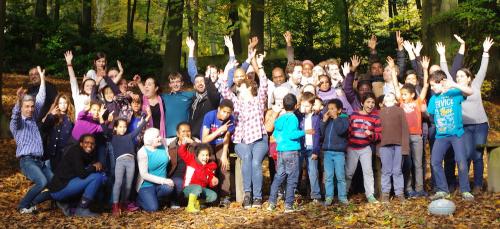
I am happy and grateful to God that all of the disciples in our church in Brussels (picture below) are safe. God clearly watched over every one of them. One of our brother's jobs brings him to the airport every morning. He is safe. Another sister, originally from Boston but currently living in Switzerland, often travels to Brussels for her job. The night before, her work asked her to stay in town another day. She was scheduled to fly Tuesday morning and would have been right where one of the bombs exploded. One sister works near the Maelbeek metro stop.
God watches over his children. We are all safe in the shelter of his wings. We know we are here for such a time as this, and so we will continue to preach the gospel, we will continue to love those around us, to spread this message of unconditional love, grace and the kindness of our Lord and Savior. He did not retaliate, he did not repay evil for evil. Instead he suffered and hung on a cross so that we, and those who oppose us, might be saved. Our victory has been, and always be, in a resurrected Lord. We thank all of you for your continued prayers for all of Europe but we ask you to especially pray that his light and love will shine evermore brightly through us as we hold out the gospel of peace to a hurting world.
Happy Easter!
Carol McGuirk
More from the International Church of Christ

Imagine you are at a neighborhood barbecue. Your new neighbor arrives late, dressed casually, and barely speaks. Someone whispers, “She thinks she’s too good for us.” You feel the quick sting of that snap judgment. Later, you learn she just lost her husband and is quietly grieving. In that moment, you sense the discomfort of judging wrongly, a rush to conclusions that harms relationships and reveals more about our own hearts than the other person. Yet, the same evening, when another guest makes a racist joke, you feel an inner nudge to speak up. Is that also “judging”? This everyday tension captures what Jesus presents in Scripture: a divine balance between grace-filled restraint and righteous discernment. The two commands in tension “Do not judge, or you too will be judged.” – Matthew 7: “Stop judging by mere appearances, but instead judge correctly.” – John 7:24 At first glance, these seem contradictory. Don’t judge. Judge correctly. Which is it? Matthew 7 warns against a critical, hypocritical spirit that condemns others while ignoring our own faults. The context continues: “For in the same way you judge others, you will be judged, and with the measure you use, it will be measured to you” (Matthew 7:2). Jesus then uses the vivid image of someone with a plank in their own eye trying to remove a speck from another’s. Notice the aim: “then you will see clearly to remove the speck.” Self-examination is not a reason to stay silent. It is how we become safe enough to speak (Matthew 7:3-5). John 7, however, shows Jesus defending his healing on the Sabbath. He challenges the religious leaders: stop superficial, appearance-based judgments and instead apply right, truthful judgment aligned with God’s character and Word. This is not a contradiction but a divine tension, two truths that must be held together. We are called to humility and self-examination (do not judge harshly or hypocritically), while also exercising discernment and moral clarity (judge correctly, according to truth). Christianity rejects both naive permissiveness (“anything goes, no one can say anything”) and harsh legalism (constant condemnation without grace).

Here are answers to some frequently asked questions about next year’s trip to Mt. Kilimanjaro.
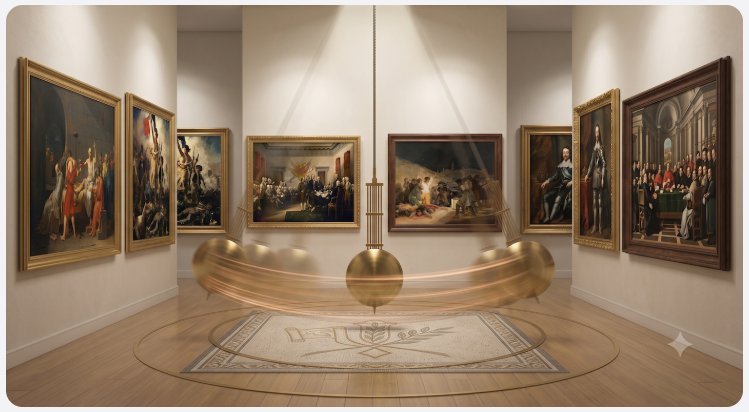
The physics of the pendulum Picture an old grandfather clock in a quiet hallway. Its long brass pendulum swings steadily: tick, tock, tick, tock. Now give that pendulum a hard shove to the right. It does not simply glide back to the center and stop. It races right past the middle and sways just as far to the left. Left to its own momentum, a pendulum never rests at either extreme; it finds peace only when it hangs still at the center, held by gravity and its fixed point. The church behaves in much the same way. Push her too far toward one side of a truth and she does not gently settle into balance, she swings. Often for a whole generation toward the opposite error, and then back again, wounding people at both ends of the arc. And here is the crucial thing the clock teaches us: the pendulum comes to rest not by being frozen in place, but by being held. Balance is not the absence of force; it is the fixed point that keeps opposing pulls in tension so that the weight can finally hang still.