Embracing Divine Tension: Already but Not Yet (Part 8)
On June 6, 1944, Allied forces stormed the beaches of Normandy. In the brutal hours that followed, the course of World War II shifted permanently. The enemy’s capacity to win had been broken. And yet, the fighting raged on for 11 more months. Soldiers still died; cities still burned. Berlin had not yet fallen.
But every Allied commander knew the truth: what happened on D-Day determined what would happen on V-E Day (Victory in Europe Day). Victory was certain, even though it was not yet complete.
Through his death and resurrection, Jesus Christ stormed the ultimate beach. The decisive battle against sin, death, and darkness has already been won. And yet, we are not yet living in the full experience of that victory. The war is over, and the war is still going. Not because the outcome is in doubt, but because we live between D-Day and V-E Day.
This pattern – already won, not yet complete – is the “already but not yet,” and it is not a contradiction. It is the very fabric of the Christian life.
As we’ve seen across this series, the fullness of God’s truth is rarely found in tidy, isolated categories. It is held in divine tension, where seemingly opposing realities coexist, each completing and guarding the other. And nowhere is that tension more vivid than in what Scripture says about our own salvation.
The Biblical paradox
The New Testament speaks of our adoption, redemption, salvation, sanctification, and resurrection in a way that constantly surprises us: as both accomplished facts and future hopes. This is not a theological error; it is the deliberate structure of a story that is already finished by the Author but still being written by the characters.
Adoption
- Already: “You have received the Spirit of adoption as sons, by whom we cry, ‘Abba! Father!’” – Romans 8:15
- Not yet: “We ourselves groan inwardly as we wait eagerly for adoption as sons, the redemption of our bodies.” – Romans 8:23
Redemption
- Already: “In him we have redemption through his blood, the forgiveness of sins.” – Ephesians 1:7
- Not yet: “You were sealed for the day of redemption.” – Ephesians 4:30
Salvation
- Already: “For it is by grace you have been saved, through faith.” – Ephesians 2:8
- Not yet: “How much more shall we be saved from God’s wrath through him!” – Romans 5:9
Sanctification and resurrection
- Already: We are already sanctified in Christ and raised with him. – 1 Corinthians 1:2 and Ephesians 2:6
- Not yet: We await final sanctification and the future resurrection of the dead at the last trumpet. – 1 Thessalonians 5:23–24 and 1 Corinthians 15:52
The same salvation is being described as past, present, and future. We have been saved. We are being saved. We will be saved. This is not a contradiction, it is the both/and of divine tension.
Understanding the timeline
To make sense of this, we need to understand how Scripture structures history. Jewish thought divided all of time into two ages: “This age” — the present age marked by sin, suffering, and death — and “the age to come,” when God would restore all things, defeat evil, and reign in fullness.
The expectation was that these two ages would be strictly sequential: this age ends, the next one begins. What no one fully anticipated was that through the resurrection of Jesus and the outpouring of the Holy Spirit, the “age to come” broke into “this age” before it was over. We now live in what theologians call “the age between the ages.” The Kingdom of God has arrived, and it is still arriving.
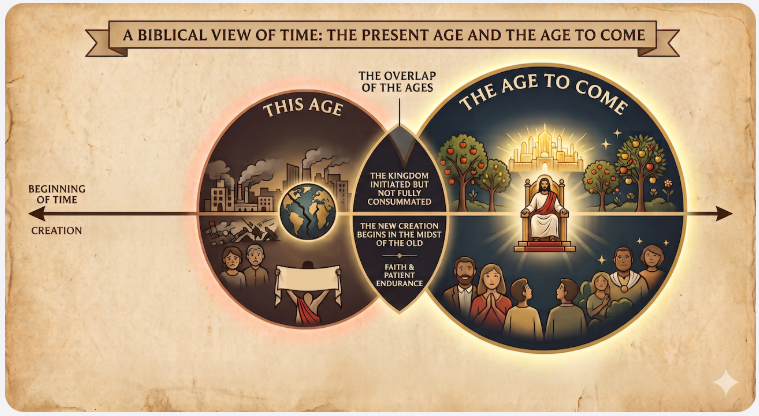
Think of it as two overlapping circles on a timeline. Everything that belongs to the coming Kingdom – forgiveness, the Spirit, new creation – has already begun breaking in. Everything that marks this age – suffering, decay, death – is still present. We live in the overlap.
This is not confusion; it is the design.
The tension in Jesus’ teaching
Jesus spoke of the Kingdom as simultaneously present and still coming. Two of his parables capture this precisely.
The wheat and the tares (Matthew 13:24–30): The Kingdom is already present and growing, but it coexists with evil in the world until the final harvest at the end of the age. The farmer does not prematurely rip out the weeds, both grow together until the appointed time. We live in that “together” season.
The growing seed (Mark 4:26–29): A farmer scatters seed and the crop grows; first the stalk, then the head, then the full grain. The Kingdom has been inaugurated but awaits its full maturity at the Second Coming. Growth is happening. Completion is not yet here.
Both parables refuse to let us choose between ‘already’ and ‘not yet’; they hold them together in dynamic tension. There is no static picture; the Kingdom is on the move, growing toward a certain conclusion. It is just not yet finished.
Why the tension matters
As we’ve seen throughout this series, every divine tension we refuse to hold produces a theological imbalance. The “already but not yet” is no different.
The prosperity gospel is what happens when someone seizes the “already” and strips away the “not yet.” If all blessings are available right now, like health, wealth, complete victory, there is no category left for Romans 8:17, which tells us we share in Christ’s sufferings as well as his glory. There is no room for Paul’s contentment in prison, or for the groaning of creation in Romans 8:22. “Name it and claim it” is not hyper-faith; it is only half of the story.
Spiritual despair is the opposite failure. If we are so gripped by the “not yet” – by our failures, unhealed wounds, and unanswered prayers – that we forget the “already,” we begin to live as though the war is still undecided. We forget that we are sealed (Ephesians 1:13), that nothing can separate us from God’s love (Romans 8:38–39), and that the same Spirit who raised Christ lives in us (Romans 8:11).
On sovereignty and prayer: Scripture insists God is sovereign and his purposes cannot be thwarted (Job 42:2). But if God is sovereign, why pray? The answer lies precisely in this tension. God’s purposes are sure, and prayer is one of the God-ordained means by which he works them out in time. Scripture holds the two together rather than collapsing one into the other. We pray not to change God’s mind, but to participate in his story.
When we hold both sides of this tension, we avoid twin dangers: entitlement on one side, despair on the other. We celebrate what Christ has already secured, and we groan with honest longing for what is yet to come.
Living in the tension
Understanding this in theory is one thing. The harder question is: how do you actually live here, today?
When you face persistent sin or struggle:
- The “already” says — you are a new creation (2 Corinthians 5:17), freed from sin’s dominion (Romans 6:14), indwelt by the Holy Spirit. You are not who you were.
- The “not yet” says — the flesh is still active, the world still broken, your transformation is not yet complete (Philippians 1:6).
- Living in the tension — means neither minimizing your sin (“it doesn’t matter, I’m forgiven”) nor being crushed by it (“I can’t overcome”). It means fighting from a position of victory, not for one.
When prayers go unanswered:
- The “already” says — God hears you, loves you, and works all things together for good (Romans 8:28).
- The “not yet” says — we do not yet see the full picture. We groan. We wait. We hope for what we do not yet possess (Romans 8:24–25).
- Living in the tension — means holding your requests before God with both confidence and submission, not demanding what has not yet been given, while trusting what has already been secured.
When the world seems to be winning:
- The “already” says — Christ has disarmed the powers and triumphed over them (Colossians 2:15). The decisive victory is done.
- The “not yet” says — the enemy is still active, still seeking whom he may devour (1 Peter 5:8). Final judgment has not yet come.
- Living in the tension — means neither passivity (“God’s in control, nothing matters”) nor panic (“everything is falling apart”). It means confident, engaged endurance, fighting battles we know will end in a victory already secured.
When the church disappoints:
- The “already” says — the church is the body of Christ, loved and sanctified by him (Ephesians 5:25–27).
- The “not yet” says — we are all sinners saved by grace, not yet fully conformed to his image.
- Living in the tension — means giving grace without making excuses, and expecting growth without demanding perfection.
Conclusion
Return for a moment to those beaches on June 6, 1944. The soldiers who landed at Normandy were not waiting for the war to be decided. The decisive battle had been fought. They were advancing in the full assurance of a victory that was certain, even while the fighting continued around them. They carried both: the hard reality of an unfinished war, and the unshakeable confidence of an already-determined outcome.
That is the Christian life.
We live with confidence, because of what Christ has already finished. And we live with hope, because of what he has promised to complete. The harvest is guaranteed. The season is not yet over. The Kingdom has come. It has not yet fully come.
Advance accordingly.
For reflection
- Which half of this tension do you default to: the “already” (presuming on grace, skipping the groaning) or the “not yet” (living without assurance, forgetting what Christ has secured)? What does that reveal about your theology?
- Think of an area where you are waiting on God. How does holding both the “already” and the “not yet” change how you pray about it?
- Where in your life do you need to fight from a position of victory, rather than for one?
Summary: Already but not yet
| Concept | The “already” (present reality) | The “not yet” (future hope) |
|---|---|---|
| Adoption | Romans 8:15: “You have received the Spirit of adoption as sons…” | Romans 8:23: “We groan inwardly as we wait eagerly for adoption as sons, the redemption of our bodies.” |
| Redemption | Ephesians 1:7: “In him we have redemption through his blood, the forgiveness of sins.” | Ephesians 4:30: “You were sealed for the day of redemption.” |
| Salvation | Ephesians 2:8: “By grace you have been saved, through faith.” | Romans 5:9: “How much more shall we be saved from God’s wrath through him!” |
| Sanctification | 1 Corinthians 1:2: “Sanctified in Christ Jesus…” | 1 Thessalonians 5:23: “May God himself sanctify you through and through…” |
| Resurrection | Ephesians 2:6: “God raised us up with Christ…” | 1 Corinthians 15:52: “…the dead will be raised imperishable.” |
More from the International Church of Christ