
Building Parent & Teen Communication
Dave Pocta • June 19, 2017
As church leaders and youth & family leaders, one of the most important things we can do for our families is to help them with their communication at home. As kids grow up, communicating with them at a heart level can become challenging. Communication is vital to a healthy relationship. We need to make sure that we are talking through important issues and guiding our children through the turbulent waters of young adulthood.
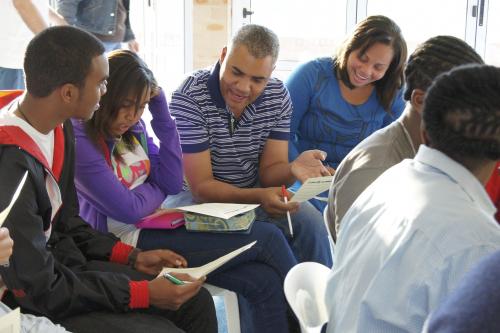
We often divide families when they walk in the door of our churches. We have parenting classes and teen devos. We see the need to meet individual needs. We see the need for teens to have a place they can call their own. These are critical needs to meet but we must also find ways to get them together, in the same room, interacting. When we disciple a married couple, we sit together. We need to hear both sides of the story. We need the complete picture. The same is true in teen’s homes. We need to communicate with both together. We need to facilitate and train them to have spiritual communication.
In our ministries in Chicago and Johannesburg, we have had monthly teen & teen parent devotionals. We get the families to come together, sit together, and learn together. We typically start off the time with an activity they can do as a family. It may be a game, a project, a survey, or a competition. We believe in active participation! Our devos are typically very interactive. In the first devo we did with the teens and parents in the Northwest Region in Joburg (where Beth and I are at) we talked about “Building a Spiritual Household”. We showed a number of video clips where teens and parents were communicating sinfully. After each video clip we stopped and asked the questions, “How did the parent sin against the teen?” and “How did the teen sin against the parent?” This always prompts great discussion! After identifying how teens and parents can sin against each other we talked about apologies, repentance, and forgiveness. God gives us the tools to constantly work through sin at home. This is the real hope in Christian homes!
This weekend is our second time together. We are going to devote this devotional to “Family Communication.” Our hope is to teach principles and practicals that help teens and parents communicate at a heart level.
Hopefully this sparks some ideas. Try to find ways to build healthy communication in your family’s homes!
Dave Pocta for ICOC HotNews
More from the International Church of Christ

Imagine you are at a neighborhood barbecue. Your new neighbor arrives late, dressed casually, and barely speaks. Someone whispers, “She thinks she’s too good for us.” You feel the quick sting of that snap judgment. Later, you learn she just lost her husband and is quietly grieving. In that moment, you sense the discomfort of judging wrongly, a rush to conclusions that harms relationships and reveals more about our own hearts than the other person. Yet, the same evening, when another guest makes a racist joke, you feel an inner nudge to speak up. Is that also “judging”? This everyday tension captures what Jesus presents in Scripture: a divine balance between grace-filled restraint and righteous discernment. The two commands in tension “Do not judge, or you too will be judged.” – Matthew 7: “Stop judging by mere appearances, but instead judge correctly.” – John 7:24 At first glance, these seem contradictory. Don’t judge. Judge correctly. Which is it? Matthew 7 warns against a critical, hypocritical spirit that condemns others while ignoring our own faults. The context continues: “For in the same way you judge others, you will be judged, and with the measure you use, it will be measured to you” (Matthew 7:2). Jesus then uses the vivid image of someone with a plank in their own eye trying to remove a speck from another’s. Notice the aim: “then you will see clearly to remove the speck.” Self-examination is not a reason to stay silent. It is how we become safe enough to speak (Matthew 7:3-5). John 7, however, shows Jesus defending his healing on the Sabbath. He challenges the religious leaders: stop superficial, appearance-based judgments and instead apply right, truthful judgment aligned with God’s character and Word. This is not a contradiction but a divine tension, two truths that must be held together. We are called to humility and self-examination (do not judge harshly or hypocritically), while also exercising discernment and moral clarity (judge correctly, according to truth). Christianity rejects both naive permissiveness (“anything goes, no one can say anything”) and harsh legalism (constant condemnation without grace).

Here are answers to some frequently asked questions about next year’s trip to Mt. Kilimanjaro.

The physics of the pendulum Picture an old grandfather clock in a quiet hallway. Its long brass pendulum swings steadily: tick, tock, tick, tock. Now give that pendulum a hard shove to the right. It does not simply glide back to the center and stop. It races right past the middle and sways just as far to the left. Left to its own momentum, a pendulum never rests at either extreme; it finds peace only when it hangs still at the center, held by gravity and its fixed point. The church behaves in much the same way. Push her too far toward one side of a truth and she does not gently settle into balance, she swings. Often for a whole generation toward the opposite error, and then back again, wounding people at both ends of the arc. And here is the crucial thing the clock teaches us: the pendulum comes to rest not by being frozen in place, but by being held. Balance is not the absence of force; it is the fixed point that keeps opposing pulls in tension so that the weight can finally hang still.