
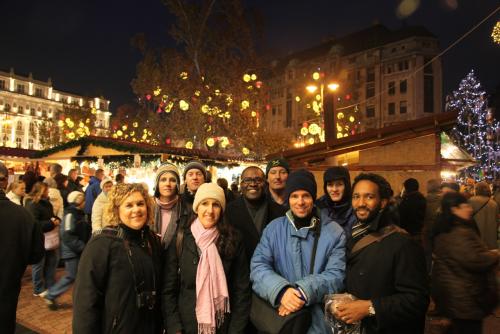
The Euro Conference in Budapest was a great success last week as over 700 disciples came from across Europe for prayer, praise, and some excellent preaching. Budapest is a beautiful city, and everyone enjoyed the Old World charm, castles, and the Danube river. (Photo: Conference participants take in some of the Christmas charm of Budapest)
BUDAPEST: Over 700 Attend EURO Conference.
Mike Taliaferro • December 8, 2011
"The first EURO Conference in 12 years was a huge success."
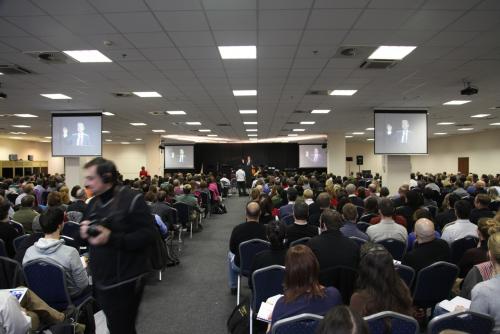
Our European churches are reviving. Evidence was everywhere. After a pretty rough decade, a whole new spirit has broken out in Europe. We heard good news from across Europe...
The UK churches are now growing, with our London church now numbering 670 disciples. London has grown by over 50 disciples in the last two years. The full time staff has also grown to 11.
In Milan, Italy, Joe and Annie Silipo report the church growing from 42 to 62 members in the last two years. Six of those conversions were in the teen ministry. Pray for their plans for satellite churches in other cities in Italy.
Most of the main capital churches are now working together well, getting and giving help, and reaching out to each other often.
The Budapest, Hungary church is our largest congregation in Continental Western Europe. They have 138 disciples, and the campus ministry has grown from 0 to 15 in the last few years. They have also sent out two couples to help lead in other Eastern European cities. They are a growing and vibrant congregation.
The 22 Glascow, Scotland, disciples had a special Sunday recently with 122 in attendance.
Thierry Fender from Geneva, Switzerland, shared how over 100 teens and preteens from across Europe came to summer camp this year. Many have been baptized.
The Geneva church is growing. The 90 disciples have had almost 20 baptisms in the last 20 months.
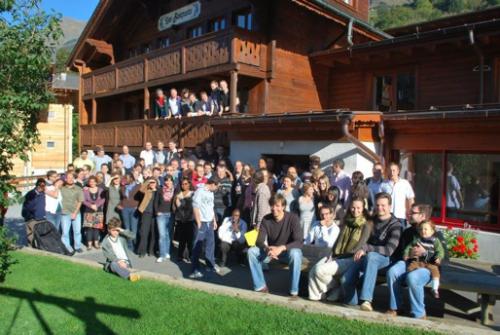
The European Bible School is meeting three times a year. Roughly 100 evangelists and church leaders meet for teaching and discipling. (Photo: Bible School)
Though the numbers were encouraging, the love and zeal of the disciples was even more impressive. The disciples are talking about new churches, raising up new leaders, and growing deeper in their walk with Jesus. It seemed clear to HotNews that the European churches are on the right track, and we should all pray for their growth and maturity in the next few years.
(One last footnote: Several came to the conference from the Middle East. The 48 disciples in Amman, Jordan have already seen 28 people baptized this year!)
More from the International Church of Christ

The physics of the pendulum Picture an old grandfather clock in a quiet hallway. Its long brass pendulum swings steadily: tick, tock, tick, tock. Now give that pendulum a hard shove to the right. It does not simply glide back to the center and stop. It races right past the middle and sways just as far to the left. Left to its own momentum, a pendulum never rests at either extreme; it finds peace only when it hangs still at the center, held by gravity and its fixed point. The church behaves in much the same way. Push her too far toward one side of a truth and she does not gently settle into balance, she swings. Often for a whole generation toward the opposite error, and then back again, wounding people at both ends of the arc. And here is the crucial thing the clock teaches us: the pendulum comes to rest not by being frozen in place, but by being held. Balance is not the absence of force; it is the fixed point that keeps opposing pulls in tension so that the weight can finally hang still.

In the messy arena of human relationships, whether in marriage, the workplace, church family, or the volatile world of online discourse, we constantly feel the pull of opposing forces. One voice urges us to defend truth fiercely; another calls us to extend grace generously. This is the divine tension of disagreement: holding both conviction and compassion without letting go of either. Today, we turn to a passage that cuts to the heart of how we handle differences: “My dear brothers and sisters, take note of this: Everyone should be quick to listen, slow to speak and slow to become angry, because human anger does not produce the righteousness that God desires.” – James 1:19-20 (NIV) James, writing to scattered believers across the nations, doesn’t offer fluffy advice. He gives a practical, counter-cultural blueprint for godly relationships: Be quick to listen. Slow to speak. Slow to anger. These aren’t suggestions for better conversations; they are directives for producing the righteousness God desires. This passage applies to husbands and wives, children and parents, bosses and workers; everyone from the pulpit to the pew. We all need to train ourselves to be better listeners. The divine tension in James’ command Here lies the tension: Listening requires humility and self-control, while speaking (especially in defense of truth) feels urgent. Anger can arise when we perceive injustice or error, yet James holds these in balance. We must lean into listening first, restrain our tongues, and guard our hearts against hasty wrath. Why? Because “human anger does not produce the righteousness that God desires.” This isn’t a ban on all anger; Jesus displayed righteous anger in the temple (John 2:13-17). But human anger, tainted by our flesh, tends toward self-justification, escalation, and sin. It rarely births the fruit of the Spirit. The tension calls us to slow down enough for the Holy Spirit to lead, rather than our adrenaline. What science reveals about anger and “hearing” Modern neuroscience echoes what James knew by inspiration. When anger flares, our brain undergoes an “amygdala hijack.” The amygdala, the brain’s alarm system tied to fight-or-flight, floods the body with adrenaline and cortisol. This redirects resources: our heart rate spikes and oxygen flows to muscles for action, but our higher reasoning centers in the prefrontal cortex – responsible for judgment, empathy, and nuanced thinking – get suppressed. In this state, our ability to truly “hear” another person diminishes dramatically. Active listening, the tool that clarifies, disarms, and seeks understanding, becomes nearly impossible. We filter everything through threat detection, empathy drops, and we stop processing the other’s words for their actual meaning. Instead, while they are still speaking we start crafting rebuttals or counterattacks. This explains why conflicts escalate so quickly: we literally cannot hear well when flooded with anger. James’ call to be slow to anger is not just spiritual wisdom; it aligns with how God designed our brains to function best when governed by self-control rather than unchecked emotion. Recognizing our physiological limits isn’t about suppressing feelings, it’s about guarding our capacity for reason so we don’t accidentally sabotage the very justice we seek to defend. Even if the other person is operating out of a completely hijacked, high-emotion state, our calling to maintain self-control and clear thinking remains. When our prefrontal cortex goes offline, our hijacked brain defaults to intellectual shortcuts. This emotional flooding is precisely what predisposes us toward constructing caricatures, like the straw man, rather than engaging with the actual person.

From July 19-26, 2027, DT Travel invites parents and their teenage or older children for an unforgettable journey to Mount Kilimanjaro, the highest peak in Africa.